Table of Contents
Lean manufacturing is a set of techniques for eliminating waste and improving flow, developed at Toyota and since adopted across manufacturing, healthcare, and services. This guide covers 25 of the core tools, what each one does, and where it fits.
What Are Lean Manufacturing Tools and Why Are They Important?
Lean manufacturing tools are techniques and methods designed to eliminate waste, improve efficiency, and enhance the overall quality of production processes. These tools are fundamental to the lean methodology, which originated from the Toyota Production System and has since been adopted by industries worldwide.
The importance of lean tools in manufacturing includes helping organizations:
- Identify and eliminate various types of waste
- Streamline workflows and reduce production time
- Improve product quality and consistency
- Enhance employee engagement and problem-solving skills
- Increase customer satisfaction through faster delivery and higher quality
The Top 25 Lean Manufacturing Tools
1. Value Stream Mapping (VSM): How Can It Optimize Your Production Flow?
Value stream mapping is a visual tool used to document, analyze, and improve the flow of information and materials required to produce a product or service. This lean tool helps identify waste and bottlenecks in the production process.
Key benefits include:
- Providing a clear picture of the entire production process
- Identifying non-value-adding activities
- Highlighting opportunities for improvement in the workflow
2. 5S System: What Are the Five Steps to a More Organized Workplace?
The 5S system is a workplace organization method using five Japanese words: Seiri (Sort), Seiton (Set in Order), Seiso (Shine), Seiketsu (Standardize), and Shitsuke (Sustain). This lean tool focuses on creating and maintaining an organized, clean, and efficient work environment.
Implementing the 5S system can lead to:
- Reduced waste and improved productivity
- Enhanced workplace safety
- Improved equipment maintenance and longevity
- Increased employee morale and engagement
3. Kaizen: How Does Continuous Improvement Drive Manufacturing Excellence?
Kaizen, which means "change for the better" in Japanese, is a philosophy of continuous improvement that involves all employees, from top management to frontline workers. This lean tool emphasizes making small, incremental changes that accumulate over time. Read more in our guide to mastering Kaizen events.
Key aspects include:
- Encouraging employee involvement in problem-solving
- Promoting a culture of continuous improvement
- Focusing on both process and results
- Implementing rapid improvement events (Kaizen events)
4. Six Sigma: What Role Does Statistical Analysis Play in Lean Manufacturing?
Six Sigma is a data-driven approach to eliminating defects and reducing variability in manufacturing processes. This methodology uses statistical analysis to identify and correct the root causes of quality issues.
Benefits include:
- Improved product quality and consistency
- Reduced defect rates and rework
- Enhanced customer satisfaction
- Cost savings through reduced waste and improved efficiency
5. Kanban: How Can Visual Management Improve Production Flow?
Kanban is a visual management system that helps regulate the flow of goods both within a factory and with outside suppliers and customers. This lean tool uses cards or other visual cues to signal when more materials are needed.
Key advantages include:
- Improved inventory management
- Reduced waste and carrying costs
- Enhanced production flexibility
- Better alignment with customer demand
6. Root Cause Analysis (RCA): Why Is Identifying the Source of Problems Crucial?
Root cause analysis is a problem-solving method used to identify the underlying causes of issues or defects in the manufacturing process. This lean tool helps prevent problems from recurring by addressing fundamental sources.
Common RCA techniques include:
- The 5 Whys method
- Fishbone diagrams (Ishikawa diagrams)
- Fault tree analysis
- Pareto analysis
7. Total Productive Maintenance (TPM): How Can Equipment Reliability Be Maximized?
Total Productive Maintenance is a company-wide approach to equipment maintenance that aims to achieve perfect production with no breakdowns, no small stops or slow running, no defects, and no accidents.
Key components include:
- Autonomous maintenance by operators
- Planned maintenance schedules
- Early equipment management
- Quality maintenance
- Education and training
8. Poka-Yoke (Error-Proofing): What Techniques Prevent Mistakes in Manufacturing?
Poka-Yoke, which means "mistake-proofing" in Japanese, refers to any mechanism in a lean manufacturing process that helps an equipment operator avoid mistakes. These techniques are designed to prevent defects from occurring in the first place.
Examples include:
- Physical design features that prevent incorrect assembly
- Warning systems that alert operators to potential errors
- Checklists and standardized procedures
- Automatic shut-offs for equipment when errors are detected
9. Standardized Work: Why Is Consistency Key in Lean Manufacturing?
Standardized work involves creating precise procedures for each operator's work in a production process. This lean tool establishes the best practices for each task and ensures that all workers perform operations in the same way.
Benefits include:
- Reduced variability in processes
- Improved quality and productivity
- Easier training of new employees
- A foundation for continuous improvement efforts
10. Heijunka (Production Leveling): How Can Production Be Balanced to Meet Demand?
Heijunka is a technique used to level production by both volume and product mix. This lean tool aims to minimize fluctuations in production and create a steady, predictable flow of work.
Key aspects include:
- Distributing production volume and mix evenly over time
- Reducing inventory and lead times
- Improving flexibility to meet customer demand
- Balancing workload for employees and equipment
11. Single-Minute Exchange of Die (SMED): Can Quick Changeovers Boost Productivity?
SMED is a lean manufacturing tool designed to reduce the time it takes to complete equipment changeovers. The goal is to convert as many changeover steps as possible to "external" (performed while the equipment is running).
Benefits include:
- Increased machine utilization
- Improved production flexibility
- Reduced inventory levels
- Enhanced ability to produce smaller batch sizes
12. Gemba Walks: Why Is "Going to the Actual Place" Important in Lean Management?
Gemba walks involve managers and leaders regularly visiting the shop floor or workplace to observe processes, identify waste, and engage with employees. This lean tool emphasizes the importance of first-hand observation and direct communication.
Key benefits include:
- Improved understanding of actual work processes
- Enhanced communication between management and frontline workers
- Quicker identification and resolution of issues
- Promotion of a culture of continuous improvement
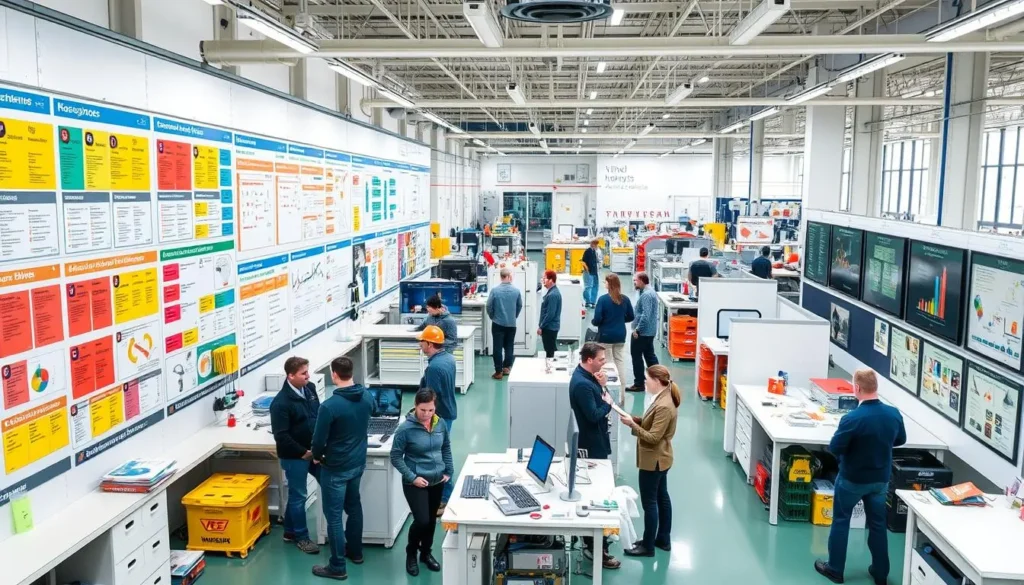
13. Visual Management: How Can Visual Cues Improve Workplace Efficiency?
Visual management involves using visual cues, such as signs, color-coding, and displays, to communicate important information quickly and effectively in the workplace. This lean tool aims to make the status of processes easily understandable at a glance.
Examples include:
- Andon boards displaying production status
- Shadow boards for tool organization
- Color-coded floor markings for traffic flow and storage areas
- Performance metric displays
14. Just-In-Time (JIT) Production: What Are the Benefits of Producing Only What's Needed?
Just-In-Time production is a lean manufacturing strategy that aims to produce only what is needed, when it is needed, and in the amount needed. This approach minimizes inventory levels and reduces waste associated with overproduction.
Key advantages include:
- Reduced inventory costs
- Improved cash flow
- Enhanced production flexibility
- Faster detection of quality issues
15. Cellular Manufacturing: How Can Grouping Machines Enhance Efficiency?
Cellular manufacturing involves arranging production equipment and workstations into groups, or cells, to facilitate the production of similar products. This lean tool aims to improve efficiency by reducing material handling.
Benefits include:
- Reduced lead times
- Improved product quality
- Enhanced flexibility to meet changing customer demands
- Better utilization of space and equipment
16. Takt Time: Why Is Synchronizing Production with Customer Demand Crucial?
Takt time is the rate at which a finished product needs to be completed to meet customer demand. This lean tool helps manufacturers align their production pace with customer requirements.
Key aspects include:
- Calculating the available production time and customer demand
- Balancing workloads across production lines
- Identifying and addressing bottlenecks
- Continuously adjusting production rates to meet changing demand
17. Overall Equipment Effectiveness (OEE): How Can Equipment Performance Be Measured and Improved?
Overall Equipment Effectiveness is a metric used to evaluate how effectively manufacturing equipment is being utilized. This lean tool takes into account three factors: availability, performance, and quality.
Benefits include:
- Identifying losses in equipment utilization
- Prioritizing improvement efforts
- Benchmarking performance across different equipment or plants
- Measuring the impact of improvement initiatives
18. Plan-Do-Check-Act (PDCA) Cycle: What Is the Scientific Approach to Problem-Solving?
The Plan-Do-Check-Act cycle, also known as the Deming cycle, is a systematic approach to problem-solving and continuous improvement. This lean tool provides a structured method for implementing and evaluating changes.
The four stages are:
- Plan: Identify the problem and develop a hypothesis for improvement
- Do: Implement the planned change on a small scale
- Check: Evaluate the results of the change
- Act: If successful, implement the change on a larger scale; if not, begin the cycle again
19. Andon System: How Can Real-Time Visual Feedback Improve Quality Control?
An Andon system is a visual management tool that provides real-time feedback about the status of production processes. This lean tool typically uses lights or display boards to signal problems or abnormalities in the production line.
Key benefits include:
- Rapid identification and response to quality issues
- Improved communication between operators and supervisors
- Enhanced transparency in production processes
- Empowerment of operators to stop production when problems arise
20. Bottleneck Analysis: How Can Identifying Production Constraints Lead to Improvements?
Bottleneck analysis is a technique used to identify the part of a manufacturing process that limits the overall throughput. This lean tool focuses on finding and addressing the constraints that slow down production.
Steps include:
- Identifying the bottleneck in the process
- Exploiting the bottleneck to maximize its efficiency
- Subordinating other processes to support the bottleneck
- Elevating the bottleneck's capacity
- Repeating the process for the next constraint
21. Continuous Flow: What Strategies Ensure Smooth Production Without Interruptions?
Continuous flow, also known as one-piece flow, is a lean manufacturing concept that aims to move products through the production process one unit at a time, without interruption. This approach minimizes work-in-process inventory.
Key strategies include:
- Balancing workloads across production stages
- Implementing pull systems like Kanban
- Designing flexible workstations
- Minimizing transportation and waiting times
22. Value Analysis/Value Engineering (VA/VE): How Can Product Value Be Maximized?
Value Analysis and Value Engineering are systematic methods for improving the "value" of products or services. VA/VE focuses on optimizing the relationship between function, performance, and cost.
Benefits include:
- Reduced product costs without sacrificing quality
- Improved product functionality and performance
- Enhanced customer satisfaction
- Identification of innovative design solutions
23. Hoshin Kanri (Policy Deployment): How Can Strategic Goals Be Aligned Across an Organization?
Hoshin Kanri is a strategic planning process that aligns an organization's functions and activities with its key objectives. This lean tool ensures that the strategic goals of a company drive progress at every level.
Key aspects include:
- Defining long-term strategic goals
- Cascading goals down through the organization
- Developing specific action plans at each level
- Regular review and adjustment of plans
24. A3 Problem Solving: Why Is a Structured Approach to Problem Resolution Important?
A3 problem solving is a structured approach to problem-solving and continuous improvement that uses a single sheet of paper (traditionally sized A3) to document the process. This lean tool encourages a systematic, data-driven approach.
The process typically includes:
- Problem definition
- Current state analysis
- Goal setting
- Root cause analysis
- Countermeasures
- Implementation plan
- Follow-up actions
25. Total Quality Management (TQM): How Can a Company-Wide Focus on Quality Drive Success?
Total Quality Management is a management approach that seeks to improve quality and performance across all functions and levels of an organization. This comprehensive lean tool emphasizes continuous improvement and employee involvement.
Key principles include:
- Customer focus
- Employee involvement and empowerment
- Process-centered approach
- Integrated system
- Strategic and systematic approach
- Continual improvement
- Fact-based decision making
- Communications
Key Takeaways: Implementing Lean Manufacturing Tools for Continuous Improvement
- Lean tools are diverse and address various aspects of manufacturing, from process flow to quality control and strategic planning
- Successful implementation of lean tools requires a culture of continuous improvement and employee engagement
- Many lean tools are interconnected and can be used in combination for greater impact
- Data-driven decision making and visual management are crucial components of many lean tools
- The ultimate goal of lean tools is to eliminate waste, improve efficiency, and enhance customer value
Conclusion
Lean manufacturing excellence is an ongoing effort, and the 25 tools in this guide give you a tested set of starting points. Applied well, they cut waste, shorten lead times, and improve product quality.
Success with lean manufacturing requires commitment from all levels of the organization, from top management to frontline workers. It demands a shift in mindset towards continuous improvement and a willingness to challenge the status quo.
As you begin or continue your lean journey, start by assessing your current processes and identifying areas where these tools can have the most impact. Begin with small, manageable changes and build upon your successes. Lean is not about implementing every tool at once, but about choosing the right tools for your specific challenges and continuously refining your approach. Explore the five lean management principles or start with focused process improvement to target your highest-impact processes first.
Lean principles and tools have become a baseline requirement for manufacturers, not an optional upgrade. Building a culture of continuous improvement and using these tools well lets manufacturers meet evolving customer demands and grow sustainably.
The path to lean excellence may be challenging, but the rewards — in terms of improved efficiency, quality, and competitiveness — are well worth the effort. Connect with us if you'd like help building your lean toolkit.
Frequently Asked Questions
Q: What is the main goal of lean manufacturing tools?
A: The primary goal of lean manufacturing tools is to eliminate waste, improve efficiency,
and enhance overall product quality and customer value.
Q: How do I know which lean tools to implement first?
A: Start by assessing your current processes and identifying your biggest pain points or
areas of waste. Choose tools that address these specific challenges first.
Q: Can lean manufacturing tools be used in non-manufacturing industries?
A: Yes, many lean tools and principles can be adapted for use in various industries,
including healthcare, software development, and service sectors.
Q: How long does it take to see results from implementing lean tools?
A: Some improvements can be seen almost immediately, especially with tools like 5S or visual
management. However, significant, sustainable results typically require consistent effort
over months or years.
Q: Is it necessary to implement all 25 tools to achieve lean manufacturing?
A: No, it's not necessary or often practical to implement all tools at once. Focus on the
tools that best address your specific challenges and gradually expand your lean toolkit over
time.
Q: How can I ensure employee buy-in when implementing lean tools?
A: Involve employees in the implementation process, provide thorough training, and
demonstrate the benefits of lean tools. Celebrate successes and encourage a culture of
continuous improvement.
Q: Are there any risks associated with implementing lean manufacturing tools?
A: If not implemented correctly, some risks include initial productivity dips, employee
resistance, or focusing too much on tool implementation rather than problem-solving. Proper
planning and management can mitigate these risks.
Q: How do lean manufacturing tools relate to Six Sigma?
A: Lean and Six Sigma are complementary methodologies. While lean focuses on eliminating
waste and improving flow, Six Sigma aims to reduce variation and defects. Many organizations
combine the two into Lean Six Sigma.
Q: Can small manufacturers benefit from these lean tools?
A: Absolutely. Many lean tools can be scaled and adapted for small manufacturers, often with
significant benefits due to the agility and flexibility of smaller operations.
Q: How do I measure the success of lean tool implementation?
A: Key performance indicators (KPIs) such as lead time reduction, defect rates, productivity
improvements, and overall equipment effectiveness (OEE) can help measure the success of lean
implementations.